
I’ve written previously about how process needs to change depending on the stage of your project. That means remaining responsive to changing information: constantly optimising your project.
The last blog I wrote outlined how the Scrum and Kanban approaches can be adapted and used to deliver better, more efficient results. Each is applied at a different point because they deal with change differently.
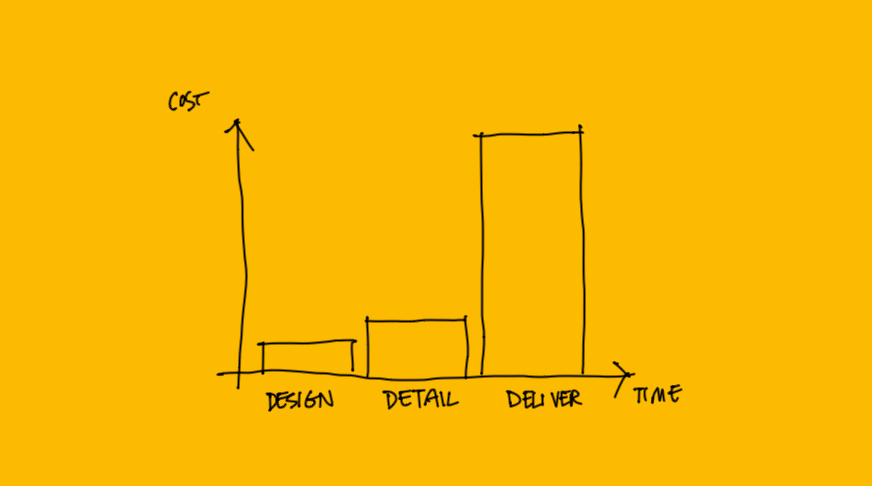
Let’s take a quick look at where the cost of change is in a project.
Why is this relevant?
A traditional project management approach heads quickly toward a point that fixes intentions. Thereafter, we see the familiar concept of the change order, or change request, invariably loading on additional fees to accommodate re-work. Sigh. While this is quite predictable when cost is the major driver in selecting a contractor, the relationship isn’t direct, and costly change orders can arise even with more experienced and expensive contractors – it’s the paradigm.
It’s predicated on a myth. It’s a case of circular reasoning that has likely cost industry trillions: the cost of change after design is high … … … because we make the cost of change after design high.
Where I’ve painted a picture with change orders cajoling you to roll your eyes in sympathy, the issue is systemic.
Believing that something can’t be changed beyond a certain point is bad.
If that’s a bad myth, what’s the reality?
Change changes.
The cost of change is relatively low – as low as it can be – until you start to deal with more than paperwork and people. Sure, your team will grow a bit as you get more serious in your intentions, but their ability to change something is, in the technology powered 21st century, a factor of how many times Ctrl + Z can be mashed, rather than the complicated print-and-mail logistics of the pre-internet age. It’s cheap.
For conventional projects, that’s a much longer period of changeability than you’ve been led to believe – it goes all the way up until you start building.
And even once you’ve started building, construction, manufacturing and so on, cost of change isn’t high immediately. It just gets high much faster compared to the people-and-paperwork phases previously: as soon as you order parts and materials, you add costs (and risks) you didn’t have earlier in the project.
Relatively speaking, your cost of change is now higher. You’re getting together an inventory of components that are specific to your project, meaning you can’t offload them easily if circumstances change – they’re less liquid.
That means you should welcome change well into the detail phase of your project, and with suitable analysis even beyond that. People change their mind, budgets shift, contexts switch, contractors change.
All these things are normal in standard project delivery. If nothing else, better late than never.
